• Home
  • News
  • Education
    • Tutorial
    • Theory
    • Lectures
    • Fabrication Series
    • Parametric Series
  • Research and Innovation
    • Portfolio
    • On-going Research
  • Publication
  • Events
  • Profile
    • Background
    • Vision
    • Mission
    • Our Team
  • Contact Us
Universitas Gadjah Mada KANAL ILMU FAKULTAS TEKNIK UNIVERSITAS GADJAH MADA
MENARA ILMU ARSITEKTUR PARAMETRIK
  • Home
  • News
  • Education
    • Tutorial
    • Theory
    • Lectures
    • Fabrication Series
      • Fabrication Series: Fabricated Wall
      • Fabrication Series: Dynamic Ceiling
      • Fabrication Series: Light in the Tunnel
      • Fabrication Series: TAK LELO LELOLALEDUNG
      • Fabrication Series: Bloomenheimer
      • Fabrication Series: E’LALANG
      • Fabrication Series: G O – B L O K E S
    • Parametric Series
  • Research and Innovation
    • Portfolio
    • On-going Research
  • Publication
  • Events
  • Profile
    • Background
    • Vision
    • Mission
    • Our Team
      • Active Members
      • Past Collaborators
      • Interns – Batch 1
      • Interns – Batch 2
  • Contact Us
  • Beranda
  • Education
  • Fabrication Series: Chips n’ Scales

Fabrication Series: Chips n’ Scales

  • Education, Fabrication Series
  • 2 April 2026, 07.01
  • Oleh: marsellapuspitasari72
  • 0

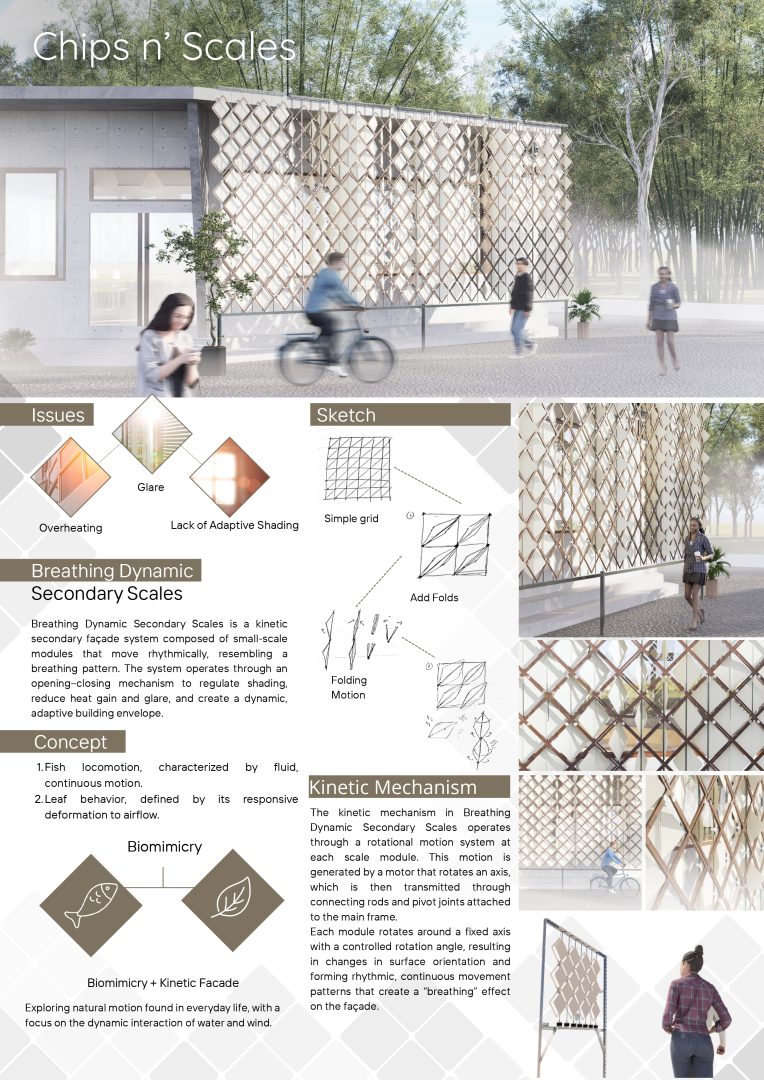
Breating Dynamic Secondary Scales 

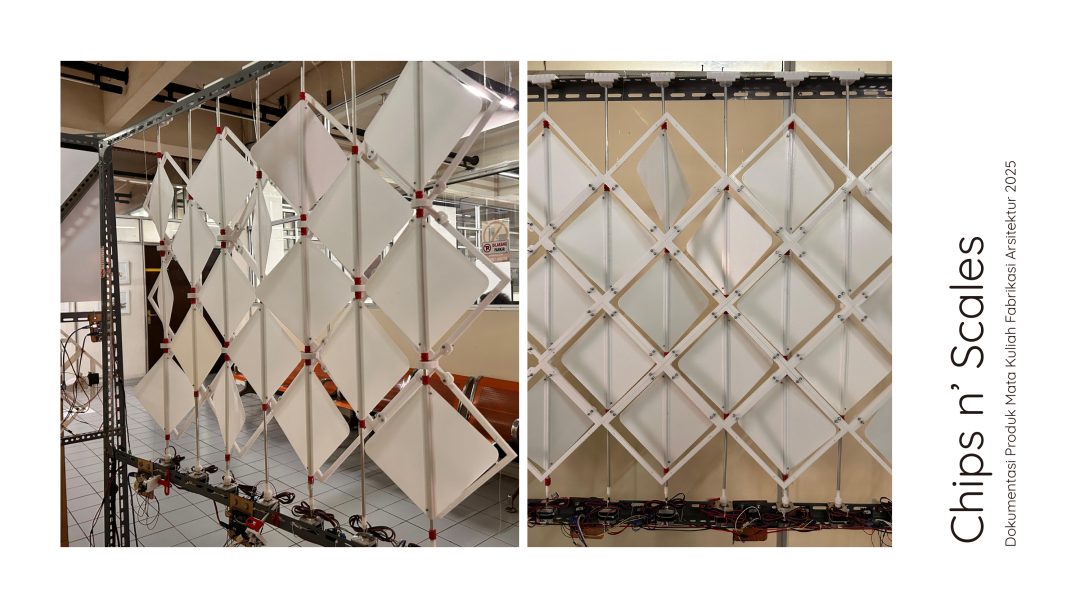
Breathing Dynamic Secondary Scales is a kinetic secondary façade system composed of small-scale modules that move rhythmically, resembling a breathing pattern. The system operates through an opening-closing mechanism to regulate shading. reduce heat gain and glare, and create a dynamic, adaptive building envelope.

Concept

1. Fish locomotion, continuous motion. characterized by fluid.

2. Leaf behavior, defined by its responsive deformation to airflow.

Biomimicry + Kinetic Facade

Exploring natural motion found in everyday life, with a focus on the dynamic interaction of water and wind.

Kinetic Mechanism

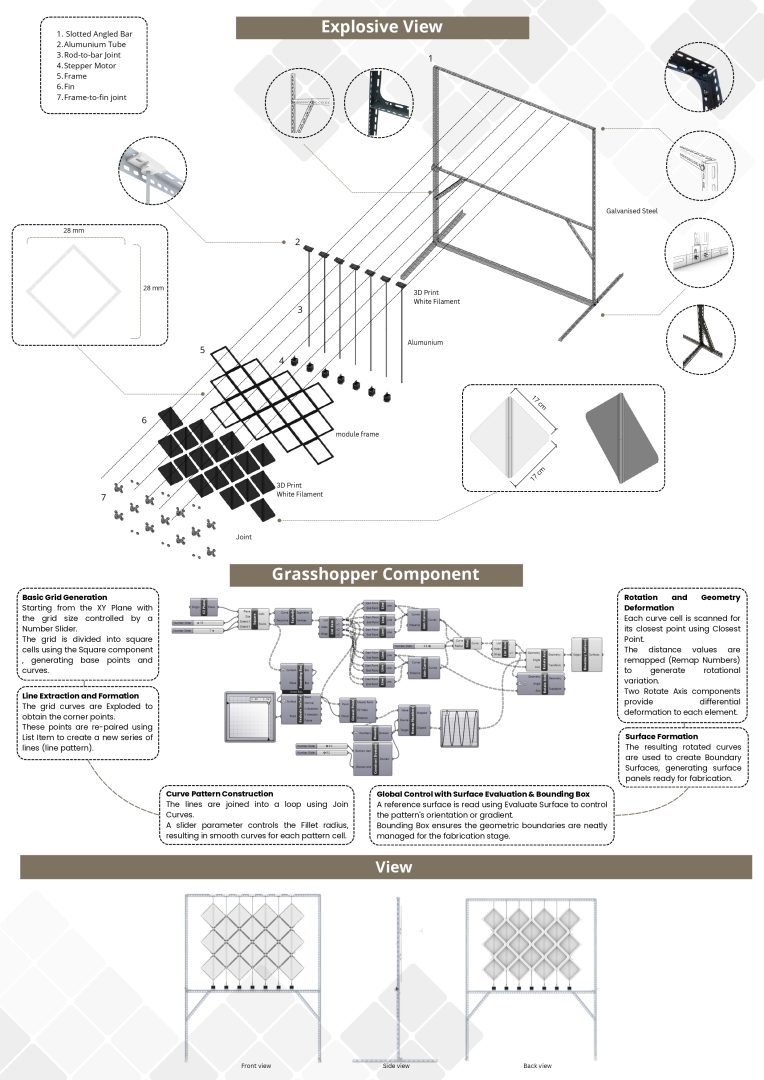
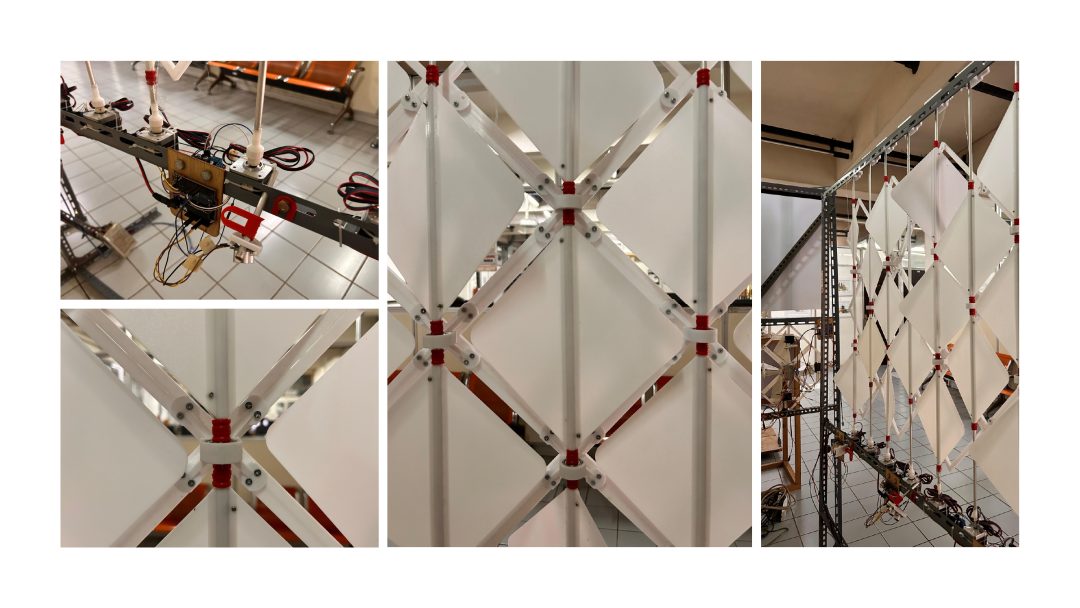
The kinetic mechanism in Breathing Dynamic Secondary Scales operates through a rotational motion system at each scale module. This motion is generated by a motor that rotates an axis, which is then transmitted through connecting rods and pivot joints attached to the main frame.

Each module rotates around a fixed axis with a controlled rotation angle, resulting in changes in surface orientation and forming rhythmic, continuous movement patterns that create a “breathing” effect on the façade.

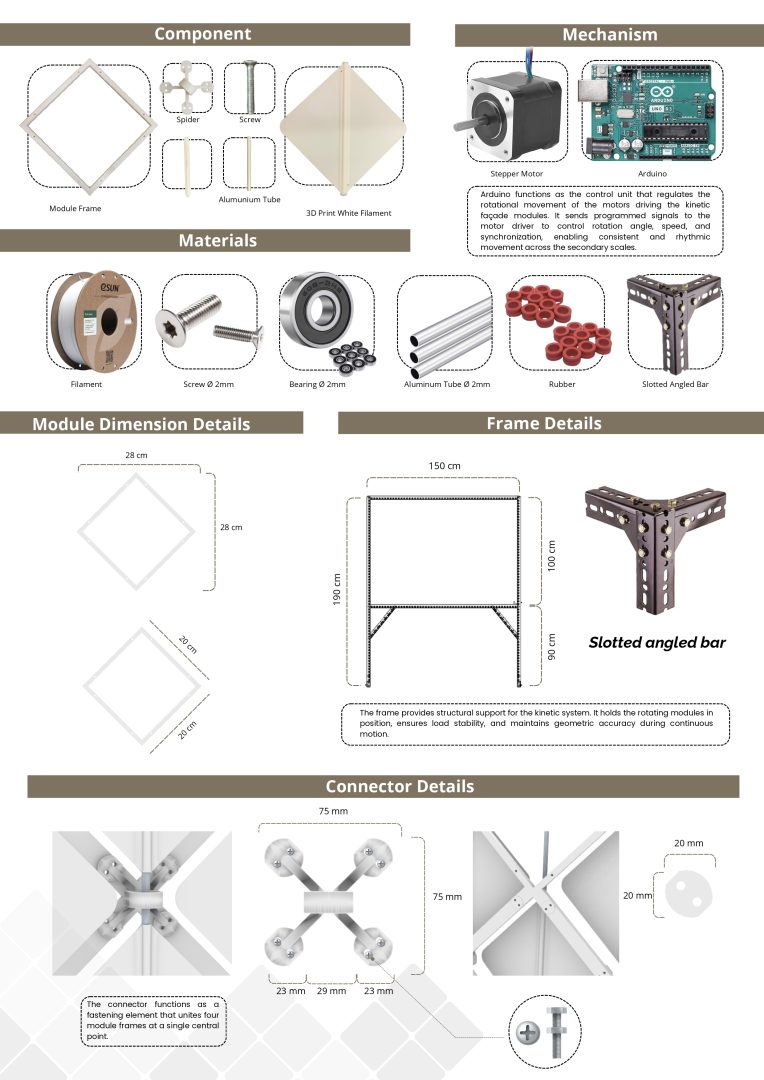
Component

  1. Module Frame
  2. Spider
  3. Screw
  4. Alumunium Tube
  5. 3D Print White Filament

Mechanism 

  1. Stepper Motor
  2. Arduino

Materials 

  1. Filament
  2. Screw 2mm
  3. Bearing 2mm
  4. Alumunium Tube 2mm
  5. Rubber
  6. Slotted Angled Bar

http://dorxlab.ft.ugm.ac.id/wp-content/uploads/sites/348/2026/03/WhatsApp-Video-2026-03-30-at-13.43.42.mp4
http://dorxlab.ft.ugm.ac.id/wp-content/uploads/sites/348/2026/03/WhatsApp-Video-2026-03-30-at-13.43.42-1.mp4

Leave A Comment Cancel reply

Your email address will not be published. Required fields are marked *

*

Recent Posts

  • Pengembangan Platform Pemindaian Objek 3D Berbasis Fotogametri untuk Digitalisasi dan Rekonstruksi Model
  • Parametric Series: Jelly Fish
  • Fabrication Series: Hikari Fan
  • Fabrication Series: Woven by Sun
  • Fabrication Series: Chips n’ Scales
Universitas Gadjah Mada

dorxlab kitchen:

Department of Architecture and Planning

Faculty of Engineering

Universitas Gadjah Mada

© dorxlab | Universitas Gadjah Mada | 2022

KEBIJAKAN PRIVASI/PRIVACY POLICY