[drawattention]
On-going Research

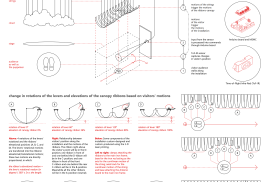
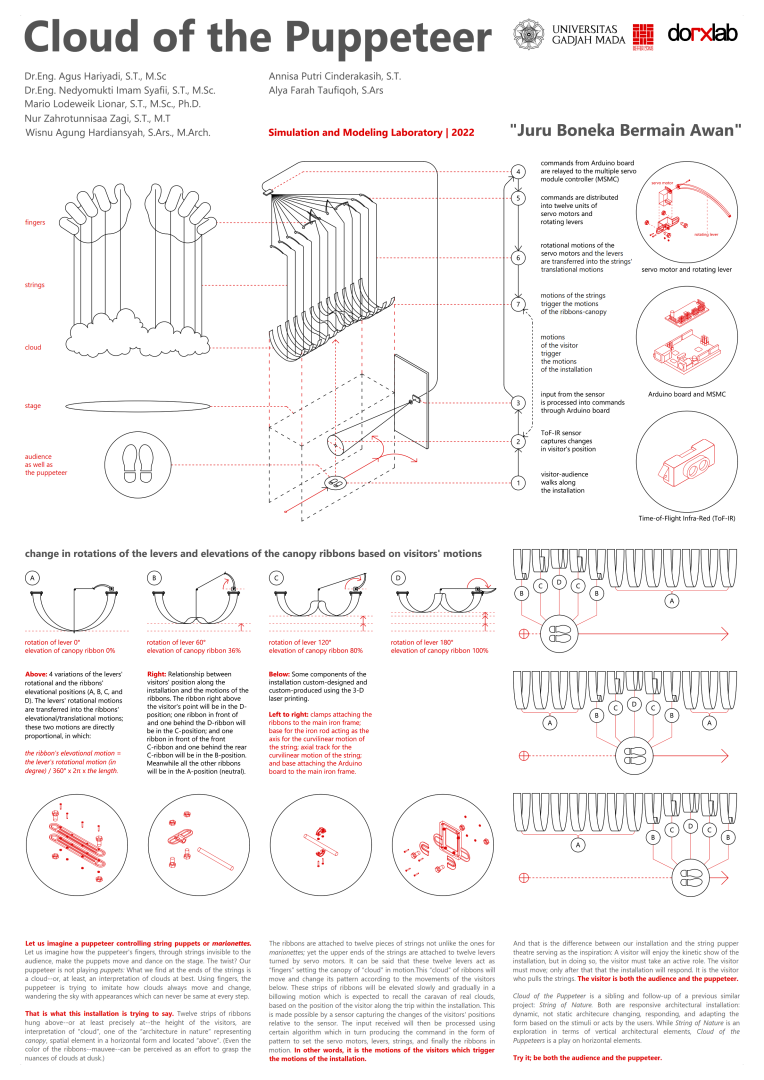
Let us imagine a puppeteer controlling string puppets or marionettes. Let us imagine how the puppeteer’s fingers, through strings invisible to the audience, make the puppets move and dance on the stage. The twist? Our puppeteer is not playing puppets: What we find at the ends of the strings is a cloud–or, at least, an interpretation of clouds at best. Using fingers, the puppeteer is trying to imitate how clouds always move and change, wandering the sky with appearances which can never be same at every step.
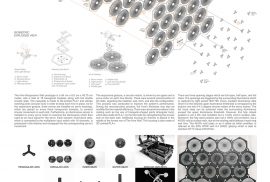
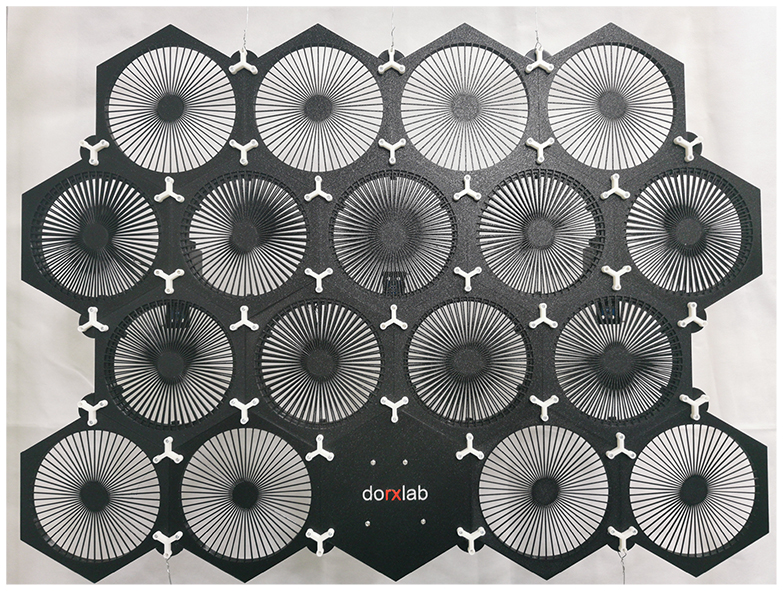
Model prototipe Hive Responsive Wall berukuran 64 cm x 6,5 cm x 48,75 cm, dengan total 18 modul heksagonal (red: Hive) bersama dengan bilah-bilah melingkar ganda. Maket model dibuat dengan memanfaatkan 3D printer dan menggunakan bahan PLA+. Setial Hive menggunakan sambungan takik (kunci melingkar) untuk menjaga setiap modul tetap di tempatnya. Sedangkan untuk gerakan responsif, tiga servo dipasang pada box servo, yang ditempatkan pada setiap tiga modul Hive, untuk melakukan gerakan melingkar pada setiap slat. Selanjutnya, sensor iluminansi dipasang pada setiap motor servo untuk memeriksa iluminasi. Sensor ini juga yang kemudian memberikan sinyal input untuk servo. Data illuminasi yang ditangkap oleh sensor dikirimkan ke multiplexer yang memiliki 16 channels. Arduino akan memproses data ini, kemudian mengirimkan sinyal kepada servo untuk menggerakkannya sesuai pemetaan dan pemrograman yang telah disiapkan sebelumnya.
Journal title : A Modular Interlocking Element for Material-Efficient Stereotomy Construction
Author : Nabila Affif, Nur Zahrotunnisaa Zagi, Agus Hariyadi, Annisa P. Cinderakasih
Accepted at August 20, 2021. Published online at Nexus Network Journal, September 17, 2021
https://doi.org/10.1007/s00004-021-00577-6
Abstract :
In the last decade, research interest in digital stereotomy has been renewed, with efficiency as a popular objective. However, along with a mainstream focus on full customization, comes a paradox of efficient design yet inefficient fabrication. Provoked by this situation, the potential of modular stereotomy is explored here. By utilizing a parametric design approach and rapid additive prototyping method, sequential experiments were executed to test seventy variations of units. As a result, a clear workflow and an optimized design were generated and used to form a modular stereotomy construction. Finally, efficiency was achieved from three standpoints: main material efficiency through complete modularity, supporting material efficiency through total elimination of shims and up to 91% reduction in falsework, and material use-value maximization through an easy assembly of form and a selection of up to six different constructional strategies to build arches with similar shape and volume.
Seperti pada kerai kinetik otomatis lainnya, tindakan meningkatkan kinerja bangunan dengan mempersempit fenestrasi berdampak pada penurunan kenyamanan visual dalam ruangan. Secara hipotetis, visibilitas dalam ruangan dapat ditingkatkan dengan terus-menerus menggerakkan tirai, sambil tetap mempertahankan konsumsi energi bangunan. Jenis pengembangan Sudare ini disebut Buzzing Sudare.
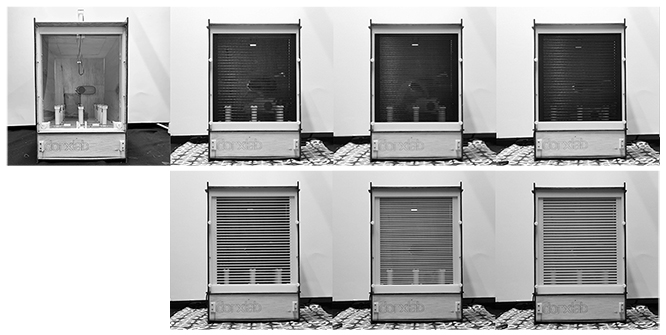
Model prototipe Buzzing Sudare berisi model ruangan dengan ukuran 28,5 cm x 19 cm x 22,5 cm, dengan WWR 100% dan satu lapis Sudare. Maket model terbuat dari papan multipleks dan menggunakan sistem knock down dan kuncian untuk menghubungkan setiap sisi horizontal dan vertikal. Selain itu, kamera web dipasang di dalam model fisik ini untuk melihat visibilitas dalam ruangan. Sensor cahaya dipasang pada dudukan yang dicetak dengan mesin 3D print dan dipasang di lantai dan atap dengan jumlah total 16 titik. Sensor cahaya ini dipergunakan untuk mengumpulkan distribusi daylight illuminance. Sensor ini terhubung ke multiplexer logger dengan 16 saluran. Data daylight illuminance tersebut kemudian diolah di Arduino dan dibaca dengan Fireflfly di Grasshopper.
Journal title: The Comparison of Device Material of Sliding Sudare Using a Prototyping Method
Author: Agus Hariyadi, Esti Setyaning Jati, Nabila Afif, Alya Farah Taufiqoh
Accepted October 11, 2020. Available online April 01, 2021. ARTEKS : Jurnal Teknik Arsitektur, Volume 6 Issue 1, April 2021.
https://doi: 10.30822/arteks.v6i1.569
Abstract:
Sliding Sudare has a big potential to be developed considered its high effectiveness in minimizing building energy consumption while still maintaining its visibility quality. Meanwhile, its original blinds that is made of bamboo cannot withstand extreme weather and have a short lifespan. Therefore, this research is to investigate the effectiveness of the other material alternatives namely stainless steel, plastic, and natural fiber. A scaled model is used for prototyping the materials in the shape of bicycle spokes, PLA+ (3D printer filament), and bamboo slats as the blinds. These everyday objects were tested in terms of their physical characteristic and were measured by four parameters (security requirement, weather resistance, construction process, and cost-effectiveness). From the research, it was concluded that bicycle spokes has the highest overall performance with the highest advantages in weather resistance requirement, cost-effectiveness, and construction; whilst PLA+ and bamboo slats have the least overall performance though both have high advantage in terms of security requirement.
A tool for automatically turn on and off mechanical ventilation based on temperature and humidity of outdoor condition.