Hikari Fan
Concept
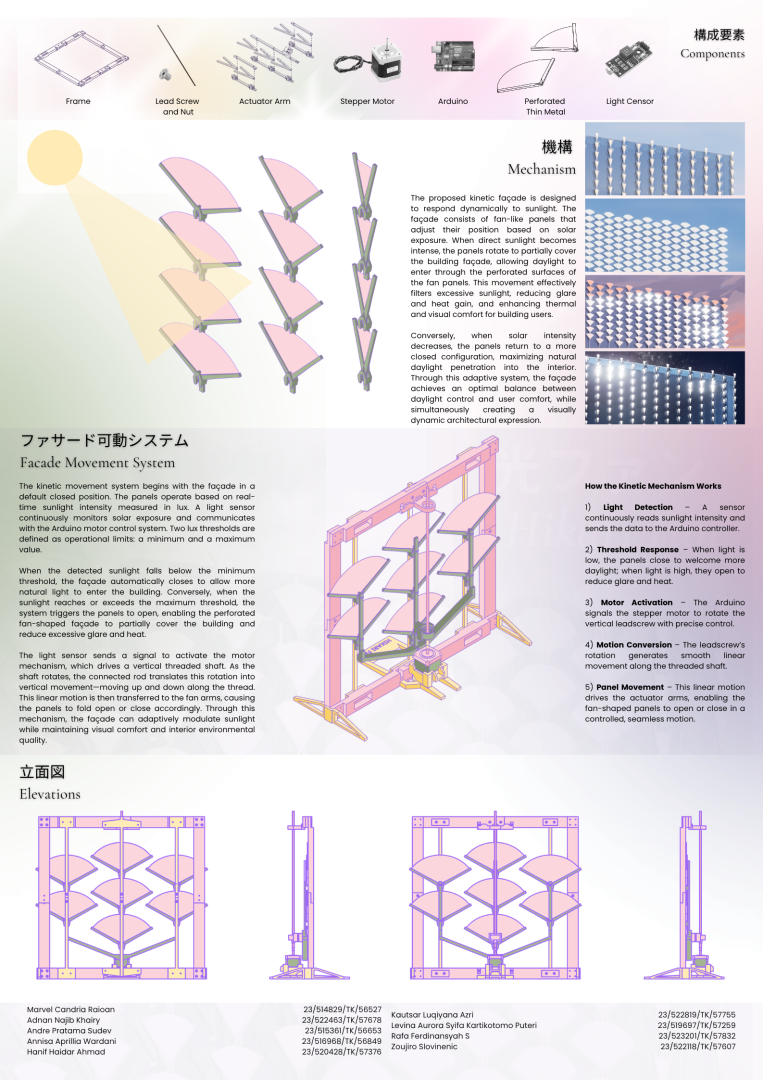
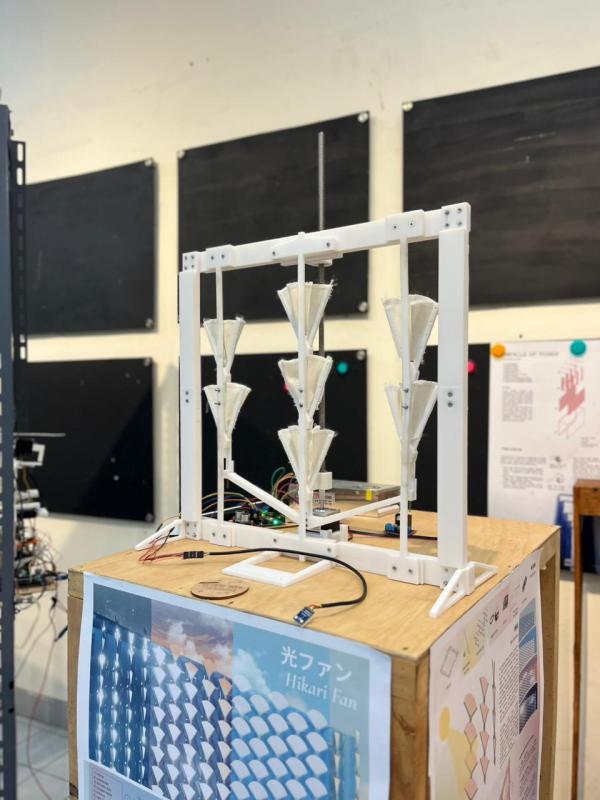
The Hikari Fan kinetic façade operates through a modular frame that houses a central leadscrew as its primary motion mechanism. A stepper motor drives the leadscrew with precise rotational control, converting rotation into smooth linear movement. This linear motion is transferred to a set of actuator arms, which translate the push–pull action into the opening and closing of the fan-shaped panels. An Arduino controller manages the entire system, processing input from light sensors to determine the appropriate angle of each fan. Together, these components create a controlled, responsive façade that adjusts its form seamlessly based on changing light intensity. This integrated mechanism ensures reliable harmony.
Hikari Fan is a kinetic façade composed of fan-shaped panels that respond solely to light intensity. Each fan opens or narrows as sunlight shifts, creating a gentle choreography of shadows across the building surface. When the light is strong, the panels partially close to reduce heat; as the light softens, they reopen, restoring brightness and visual rhythm. The result is a façade that feels alive, adaptive, poetic, and constantly transformed by the movement of light.
Components
- Frame
- Lead Screw and Nut
- Actuator Arm
- Stepper Motor
- Arduino
- Perforated Thin Metal
- Light Censor
Mechanism
The proposed kinetic façade is designed to respond dynamically to sunlight. The façade consists of fan-like panels that adjust their position based on solar exposure. When direct sunlight becomes intense, the panels rotate to partially cover the building façade, allowing daylight to enter through the perforated surfaces of the fan panels. This movement effectively filters excessive sunlight, reducing glare and heat gain, and enhancing thermal and visual comfort for building users.
Conversely, when solar intensity decreases, the panels return to a more closed configuration, maximizing natural daylight penetration into the interior. Through this adaptive system, the façade achieves an optimal balance between daylight control and user comfort, while simultaneously creating a visually dynamic architectural expression.
Facade Movement System
The kinetic movement system begins with the façade in a default closed position. The panels operate based on real-time sunlight intensity measured in lux. A light sensor continuously monitors solar exposure and communicates with the Arduino motor control system. Two lux thresholds are defined as operational limits: a minimum and a maximum value.
When the detected sunlight falls below the minimum threshold, the façade automatically closes to allow more natural light to enter the building. Conversely, when the sunlight reaches or exceeds the maximum threshold, the system triggers the panels to open, enabling the perforated fan-shaped façade to partially cover the building and reduce excessive glare and heat.
The light sensor sends a signal to activate the motor mechanism, which drives a vertical threaded shaft. As the shaft rotates, the connected rod translates this rotation into vertical movement—moving up and down along the thread. This linear motion is then transferred to the fan arms, causing the panels to fold open or close accordingly. Through this mechanism, the façade can adaptively modulate sunlight while maintaining visual comfort and interior environmental quality.
How the Kinetic Mechanism Works
1) Light Detection – A sensor continuously reads sunlight intensity and sends the data to the Arduino controller.
2) Threshold Response – When light is low, the panels close to welcome more daylight; when light is high, they open to reduce glare and heat.
3) Motor Activation – The Arduino signals the stepper motor to rotate the vertical leadscrew with precise control.
4) Motion Conversion – The leadscrew’s rotation generates smooth linear movement along the threaded shaft.
5) Panel Movement – This linear motion drives the actuator arms, enabling the fan-shaped panels to open or close in a controlled, seamless motion.